
Nata de Cassava dari Limbah Tapioka

Orang mungkin sudah banyak mengenal nata de coco sebagai penganan hasil fermentasi air kelapa. Namun, belum banyak yang mengenal nata de cassava, yaitu kudapan yang dibuat dengan memanfaatkan limbah cair dari proses produksi tepung tapioka.

Nata de cassava menjadi salah satu contoh pemanfaatan hasil samping industri tapioka menjadi produk yang memiliki nilai ekonomi. Selain limbah cair, limbah padat tapioka yang dikenal sebagai onggok juga telah dimanfaatkan untuk berbagai kebutuhan.

Pemanfaatan limbah menjadi produk baru seperti nata de cassava menunjukkan bahwa industri pengolahan singkong tidak hanya menghasilkan tepung tapioka. Dengan pengolahan lebih lanjut, bahan yang sebelumnya dianggap sebagai limbah dapat memiliki nilai tambah dan menjadi peluang usaha.

Apa Itu Nata de Cassava?

Pernahkah Anda mencicipi nata de cassava? Dari namanya, kita dapat mengetahui bahwa produk ini berkaitan dengan cassava atau singkong. Secara tampilan, nata de cassava memiliki bentuk dan tekstur yang mirip dengan nata de coco.

Nata de cassava berwarna putih dan memiliki tekstur kenyal. Perbedaannya terletak pada bahan yang digunakan. Nata de coco dibuat melalui fermentasi air kelapa, sedangkan nata de cassava dalam artikel ini dibuat dari air perasan sisa produksi tepung tapioka.

Artikel sumber menyebutkan bahwa proses fermentasi tersebut menggunakan mikroba Acetobacter xylinum. Hasil fermentasi kemudian membentuk nata yang dapat diolah lebih lanjut menjadi kudapan.

Karena berasal dari bahan baku singkong, nata de cassava juga memiliki karakter rasa yang berbeda dari nata de coco. Artikel sumber menyebut adanya cita rasa singkong pada produk tersebut.
Baca Selengkapnya

Starch … a renewable raw material

Starch is an abundant material because almost all major agricultural crops contain starch. Potatoes are commonly grown in colder climates, while cassava is an important source of starch in tropical regions. Various grain crops also contribute significantly to the world’s starch supply.

With sufficient sunlight and water, agricultural crops can produce substantial amounts of starch dry matter. Modern processing technologies make it possible to extract starch from agricultural crops with high yields and a high degree of purity.

These characteristics make starch one of the most versatile raw materials for both the food and chemical industries. At its basic level, a starch granule is a compact structure consisting primarily of glucose polymers.

Baca Selengkapnya

Bio Ethanol for automobile fuel

Bioethanol has been used as a vehicle fuel for more than a century. Henry Ford even designed the Model T to run on ethanol. However, the rapid development of the petroleum industry later made fossil fuels the dominant source of energy for transportation.

As interest in renewable energy continues to grow and the need to reduce dependence on fossil fuels becomes increasingly important, bioethanol has once again attracted attention. One agricultural crop with considerable potential as a feedstock for bioethanol production is cassava.

Cassava is particularly interesting because its roots contain starch that can be converted into sugars and subsequently fermented into ethanol. In tropical regions, cassava can also grow well under warm conditions and, depending on the production system, can be harvested throughout the year.

Baca Selengkapnya

Collaboration on cassava-based ethanol

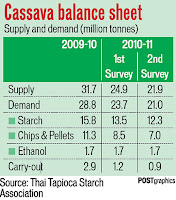
cassava balance sheet

The Thai tapioca industry is expected to focus on tapioca flour exports and Asian markets as part of its growth strategy over the next five years. Industry representatives believe that the value of Thailand’s tapioca exports could reach 100 billion baht as demand for cassava-based products continues to expand.

The strategy reflects Thailand’s effort to strengthen the value of its cassava industry by placing greater emphasis on processed tapioca products, particularly flour. At the same time, the growing demand for cassava as a feedstock for ethanol production is expected to increase competition for domestic cassava roots.

The Commerce Ministry projected that by 2016, domestic demand for cassava roots for ethanol production could surge to 13 million tonnes. Meanwhile, exports could exceed 22.5 million tonnes, bringing total demand to approximately 35.5 million tonnes. This would represent an increase of around 42% from the production level at the time.

Baca Selengkapnya

Tapioca flour and exports growth areas

cassava balance sheet

The Thai tapioca industry is expected to focus increasingly on tapioca flour exports and Asian markets as part of its growth strategy over the next five years. At the time, industry representatives were optimistic that exports of tapioca products could eventually reach 100 billion baht.

The strategy reflects a broader effort to increase the value of Thailand’s cassava industry. Rather than relying heavily on exports of tapioca chips and pellets, Thailand planned to strengthen the production and export of tapioca flour, which has applications across the food, energy, and other industrial sectors.

The Commerce Ministry projected that by 2016, domestic demand for cassava roots for ethanol production could rise to 13 million tonnes. At the same time, exports were expected to exceed 22.5 million tonnes. Combined, this would bring total cassava demand to around 35.5 million tonnes, approximately 42% higher than the production level at the time.

Baca Selengkapnya

Cassava prices continue to climb

Cassava prices continued to move upward into the second half of 2011, although the pace of increase was slower than in the previous year. Data from the Ministry of Commerce showed that the consumer price of cassava increased by 1.13% during the first half of 2011, rising from an average of Rp 2,988 per kilogram (kg) in January to Rp 3,022 per kg in June 2011.

The increase was also reflected at the farmer level. Rhomy Irawan, Second Secretary of the Cassava Farmers Association of Indonesia (Aspesindo), said that fresh cassava prices had risen significantly. The average maximum price increased from around Rp 600–650 per kg to Rp 900–1,100 per kg, although prices varied depending on the cassava variety and accessibility of the cassava plantation.

“The price of cassava has increased beyond our expectations. This might be because there has been an increase in demand. But we still need to observe whether the increase is only temporary because of speculators or whether it will remain stable,” Rhomy said by telephone on Tuesday (5/7).

Baca Selengkapnya

School’s giant cassava find

giant cassava weighing 20 kilograms harvested at a school garden

A cassava plant grown by students at Bulileka Sanatan Primary School in Labasa produced an unusually large harvest weighing 20 kilograms. The seven-month-old cassava became a surprising discovery for teachers and students when it was harvested from the school’s garden.

The plant had been cultivated by five students as part of the school’s gardening activities. When it was finally uprooted, the size of the cassava crop exceeded expectations and attracted attention within the school community.

Headteacher Narsamma Naidu said the teachers and students were delighted to see such a large cassava growing in their school garden.

“This is a rare sight and we are really surprised that we have this big crop right here in our school garden,” Ms Naidu said.

Baca Selengkapnya

Stick to rising cassava for good harvests

Tanzanian farmers have been encouraged to increase the cultivation of drought-resistant crops, particularly cassava, as changing weather patterns and inadequate rainfall continue to create challenges for agricultural production.

The recommendation was made by the Minister for Agriculture, Food Security and Cooperatives, Professor Jumanne Maghembe, in Dar es Salaam during the launch of Cassava Week. Speaking at an exhibition held at the Karimjee grounds, the minister highlighted cassava as a crop that could help Tanzania strengthen food security while creating opportunities for farmers.

According to Prof Maghembe, improving both cassava production and productivity could help the country address recurring food shortages and increase the economic benefits generated by the crop.

Baca Selengkapnya

Worth Addition Key to Cassava Revolution in Nigeria

The International Institute of Tropical Agriculture (IITA) has emphasized that Nigeria needs to give greater attention to value addition if it wants to further increase cassava production and gain more economic benefits from the crop.

According to IITA Director General Dr. Peter Hartmann, improving cassava processing could do more than increase farmers’ incomes. It could also help address unemployment by creating additional economic activities and income opportunities in cassava-growing communities.

Hartmann made the remarks at a stakeholders’ forum in Ibadan, Oyo State, marking the conclusion of the CFC-funded Cassava Value Chain Project in Nigeria. The project was implemented by IITA together with its national partners.

Baca Selengkapnya

Hilangkan Racun Pada Daun Ketela Pohon

Daun singkong ternyata memiliki kandungan protein yang cukup tinggi dibandingkan bagian lain dari tanaman singkong. Berbeda dengan umbi singkong yang lebih dikenal sebagai sumber karbohidrat dan bahan baku tapioka, daun singkong memiliki potensi sebagai sumber protein nabati.

Dalam sumber yang menjadi dasar artikel ini, penelitian terhadap 150 jenis ketela pohon menunjukkan bahwa jenis yang memiliki kandungan protein daun paling rendah sekalipun masih mengandung lebih dari 60% jenis asam amino esensial yang menjadi bagian dari penelitian tersebut.

Namun, di balik kandungan nutrisinya, daun singkong juga memiliki hal penting yang perlu diperhatikan. Daun singkong mengandung senyawa sianogenik sehingga pengolahan yang tepat diperlukan sebelum dikonsumsi.

Baca Selengkapnya