
The Thai tapioca industry is expected to focus increasingly on tapioca flour exports and Asian markets as part of its growth strategy over the next five years. At the time, industry representatives were optimistic that exports of tapioca products could eventually reach 100 billion baht.
The strategy reflects a broader effort to increase the value of Thailand’s cassava industry. Rather than relying heavily on exports of tapioca chips and pellets, Thailand planned to strengthen the production and export of tapioca flour, which has applications across the food, energy, and other industrial sectors.
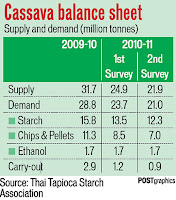
The Commerce Ministry projected that by 2016, domestic demand for cassava roots for ethanol production could rise to 13 million tonnes. At the same time, exports were expected to exceed 22.5 million tonnes. Combined, this would bring total cassava demand to around 35.5 million tonnes, approximately 42% higher than the production level at the time.
Thailand Plans to Increase Tapioca Flour Exports
Speaking at the World Tapioca Conference 2011, Yanyong Phuangrach, the permanent secretary of Thailand’s Commerce Ministry, said the country should place greater emphasis on exporting tapioca flour.
The move was intended to compensate for a potential decline in exports of tapioca chips and pellets. By increasing the proportion of flour in the export mix, Thailand could place greater emphasis on processed products rather than less-processed cassava products.
At the time, flour accounted for approximately 51% of tapioca exports. The proportion was expected to increase to 65%, while tapioca chips and pellets would account for the remaining share.
Improving the Image and Standards of Tapioca Products
Increasing export volumes was not the only priority. Thailand also needed to strengthen the image and quality standards of its tapioca flour and other cassava-based products.
According to Yanyong, maintaining accepted standards would be important for building confidence among importers, international buyers, and domestic consumers. Consistent quality is particularly important for processed products such as tapioca flour because industrial buyers often require specific and reliable product characteristics.
A stronger reputation for quality could also help Thai tapioca exporters compete more effectively in international markets.
Expanding Tapioca Markets in Asia
Thai exporters were also encouraged to expand into promising Asian markets. Countries such as China, India, and Indonesia were identified as important markets for future growth.
Focusing on Asian markets offered another potential advantage: shorter transportation distances compared with more distant export destinations. This could help exporters manage transportation and insurance costs while maintaining competitive prices.
For Thailand’s tapioca industry, expanding regional markets therefore involved not only increasing sales but also maintaining product quality and improving the efficiency of the supply chain.
Tapioca Flour Has Potential Beyond the Food Industry
Pramote Kongthong, president of the North Eastern Tapioca Trade Association, shared the view that tapioca flour has considerable potential in food, energy, and other industries.
This broad range of applications gives tapioca flour an important position in the development of Thailand’s cassava industry. Cassava can be processed into different products, allowing the industry to serve markets with different requirements.
- Food industry – tapioca flour can be used as an ingredient in various food products.
- Energy industry – cassava can be processed as a feedstock for ethanol production.
- Other industrial applications – starch-based products can be used in a variety of industrial processes.
The potential of these markets was also reflected in increasing investment in tapioca flour factories, particularly to supply major customers in China and India.
Investment in Tapioca Flour Factories
Investment in tapioca flour processing facilities was increasing as Thailand sought to meet demand from major international customers. China and India were highlighted as important destinations for Thai tapioca flour.
Greater investment in flour processing could help Thailand move further toward higher-value cassava products. Instead of exporting cassava primarily in the form of raw roots or relatively simple processed products, more cassava could be converted into flour and other derivatives before reaching international markets.
Tapioca as an Important Economic Crop in Thailand
Cassava is a major economic crop in Thailand, supporting employment and income for more than 500,000 families.
The country’s cassava plantations covered approximately 6.5 million to 7 million rai at the time of the report. This extensive cultivation base provided the raw material needed to support Thailand’s large tapioca processing and export industry.
The importance of cassava therefore extends beyond processing factories and exporters. The crop also plays a significant role in the livelihoods of farmers and communities involved in its cultivation and supply chain.
Thailand’s Cassava Production
Thailand harvested approximately 20–25 million tonnes of cassava roots each year according to the figures cited in the original report.
Approximately 75% of the cassava production was processed for export. This demonstrates how strongly Thailand’s cassava industry was connected to international demand.
With such a large share directed toward export-oriented processing, changes in international demand, product prices, and production levels could have a significant impact on the country’s cassava sector.
Thailand’s Tapioca Export Performance
The report stated that Thailand had shipped approximately 7.27 million tonnes of tapioca products in the previous year. The total value was estimated at around US$2.15 billion, equivalent to approximately 68.3 billion baht at the time.
The figure covered different types of tapioca products rather than tapioca flour alone. This included products such as flour, chips, and pellets.
Projected Tapioca Export Value
Seree Denworalak, president of the Thai Tapioca Traders Association, said tapioca exports for that year were projected to reach approximately 73 billion baht.
Of this amount, around 44 billion baht was expected to come from tapioca flour exports.
These projections reflected the industry’s confidence in continued demand for Thai tapioca products. Pramote Kongthong was also confident that Thailand’s total tapioca exports could exceed 100 billion baht within five years.
Production Estimates Could Still Change
Despite the positive outlook, the export and production projections were not necessarily final. The report noted that the figures could change following a survey of cassava root production scheduled for September.
Actual cassava availability is an important factor in determining the volume of products that can be processed and exported. A change in domestic production could therefore affect both raw material supply and export projections.
Thailand’s Tapioca Industry Growth Strategy
Based on the strategy described in the report, Thailand’s tapioca industry was pursuing several key priorities:
- Increase tapioca flour exports and reduce dependence on tapioca chips and pellets.
- Improve product standards to strengthen buyer confidence.
- Build a stronger international image for Thai tapioca flour and related products.
- Expand Asian markets, particularly China, India, and Indonesia.
- Increase investment in tapioca flour factories to serve major customers.
- Expand industrial applications for tapioca flour in food, energy, and other sectors.
- Maintain sufficient cassava supplies to support domestic processing and export demand.
Key Takeaways
- Thailand planned to make tapioca flour exports a major part of its cassava industry growth strategy.
- The share of flour exports was expected to increase from 51% to 65%.
- China, India, and Indonesia were identified as promising Asian markets.
- Tapioca flour has applications in food, energy, and other industries.
- Thailand’s cassava industry supported more than 500,000 families according to the report.
- Cassava plantations covered approximately 6.5–7 million rai at the time.
- Thailand harvested approximately 20–25 million tonnes of cassava roots annually.
- About 75% of cassava production was processed for export.
- Thailand shipped approximately 7.27 million tonnes of tapioca products worth US$2.15 billion in the previous year cited by the report.
- Tapioca exports were projected at 73 billion baht for the year discussed in the report.
- Tapioca flour was expected to account for approximately 44 billion baht of those exports.
- The industry expected total tapioca exports to potentially exceed 100 billion baht within five years.
Conclusion
Thailand’s tapioca industry was positioning tapioca flour as an increasingly important export product. The strategy focused on moving beyond tapioca chips and pellets toward products with greater processing value and broader industrial applications.
At the same time, Thailand aimed to strengthen its position in Asian markets, particularly China, India, and Indonesia. Improving product standards and maintaining buyer confidence were considered important parts of this expansion.
The country’s large cassava production base also provided strong support for the strategy. With millions of rai under cultivation and more than 500,000 families involved in the sector, cassava represented an important agricultural and economic commodity.
The projected increase in demand for cassava from ethanol production added another dimension to the industry’s growth. However, the availability of cassava roots remained an important consideration, meaning that production surveys and actual harvest levels could influence future export projections.
Overall, the strategy described in the report highlights the potential of cassava and tapioca flour as higher-value agricultural commodities. By improving processing, expanding industrial applications, strengthening quality standards, and developing regional markets, Thailand aimed to increase the economic value of its tapioca industry.
FAQ
What is Thailand’s main tapioca export strategy?
Thailand’s strategy was to increase tapioca flour exports while reducing its reliance on exports of tapioca chips and pellets.
Which countries were identified as promising tapioca markets?
China, India, and Indonesia were identified as promising markets in Asia.
How much cassava does Thailand produce each year?
The report stated that Thailand harvested approximately 20–25 million tonnes of cassava roots each year.
How much of Thailand’s cassava production is processed for export?
According to the report, approximately 75% of Thailand’s cassava production was processed for export.
How much were Thailand’s tapioca exports worth?
The report stated that Thailand shipped 7.27 million tonnes of tapioca products worth approximately US$2.15 billion, or 68.3 billion baht, in the previous year.
How much could Thailand’s tapioca exports reach?
Industry representatives were confident that total tapioca exports could exceed 100 billion baht within five years.
Why is tapioca flour important to Thailand’s cassava industry?
Tapioca flour has applications across the food, energy, and other industrial sectors. Increasing flour exports also allows more cassava to be processed into higher-value products before being exported.
How many families depend on Thailand’s cassava industry?
The report stated that the tapioca industry created jobs and income for more than 500,000 families.